
Problem:
State Medicaid agencies and Rural Health Transformation (RHT) Program leaders face significant operational challenges when translating transformation goals into measurable access improvements.
While transformation plans often identify clear objectives, expanding access to covered benefits, improving provider availability, and reducing wait-lists, execution is constrained by structural barriers. Many rural and underserved regions lack sufficient provider density, creating persistent access gaps that prevent members from receiving timely care. These gaps are especially pronounced in general dentistry and specialty care, where provider shortages result in extended wait-lists and delays in accessing covered services.
Geographic limitations further compound the problem. Members may live beyond acceptable time and distance standards, and transportation barriers, inclement weather, and limited infrastructure reduce the feasibility of accessing fixed clinical locations. As a result, states struggle to meet CMS Medicaid access requirements and network adequacy regulations, which measure access not only by provider count, but by real-world availability and time to first appointment.
Without deployable infrastructure and operational systems to expand capacity, transformation goals remain aspirational rather than operational. This leaves states at risk of continued access disparities and compliance challenges.
Solution:
We Transform Network Adequacy Requirements into Deployable Infrastructure

Solvere Health serves as a strategic implementation partner, helping states transform network adequacy requirements into deployable clinical infrastructure and measurable access improvements.
Rather than functioning solely as a mobile clinic provider, Solvere Health acts as Adequacy Architects™—designing and deploying integrated systems that combine infrastructure design, clinical deployment, and network adequacy strategy.
Solvere Health begins by aligning deployment strategy with state Rural Health Transformation objectives, Medicaid access standards, and CMS network adequacy requirements. Using geographic and access gap analysis, Solvere Health identifies regions where provider availability is insufficient to meet adequacy thresholds.
Solvere Health then designs and deploys mobile clinical infrastructure and operational support systems that expand provider capacity precisely where it is needed. This approach strengthens the effective provider network without requiring permanent facility construction.
As a strategic partner, Solvere Health integrates directly with state Medicaid agencies, managed care organizations, and public health leaders to ensure deployment aligns with transformation goals, compliance requirements, and long-term access strategies.
This deployment model enables states to:
-
Expand provider availability in rural and underserved areas
-
Reduce wait-lists for general dentistry
-
Improve access to covered benefits within Medicaid plan limits
-
Decrease time to first appointment from months to weeks —or weeks to days
-
Meet CMS and, state time and distance network adequacy standards
By converting transformation plans into deployable infrastructure, Solvere Health enables states to operationalize network adequacy improvements.
We’re not simply a mobile clinic provider—
Results:
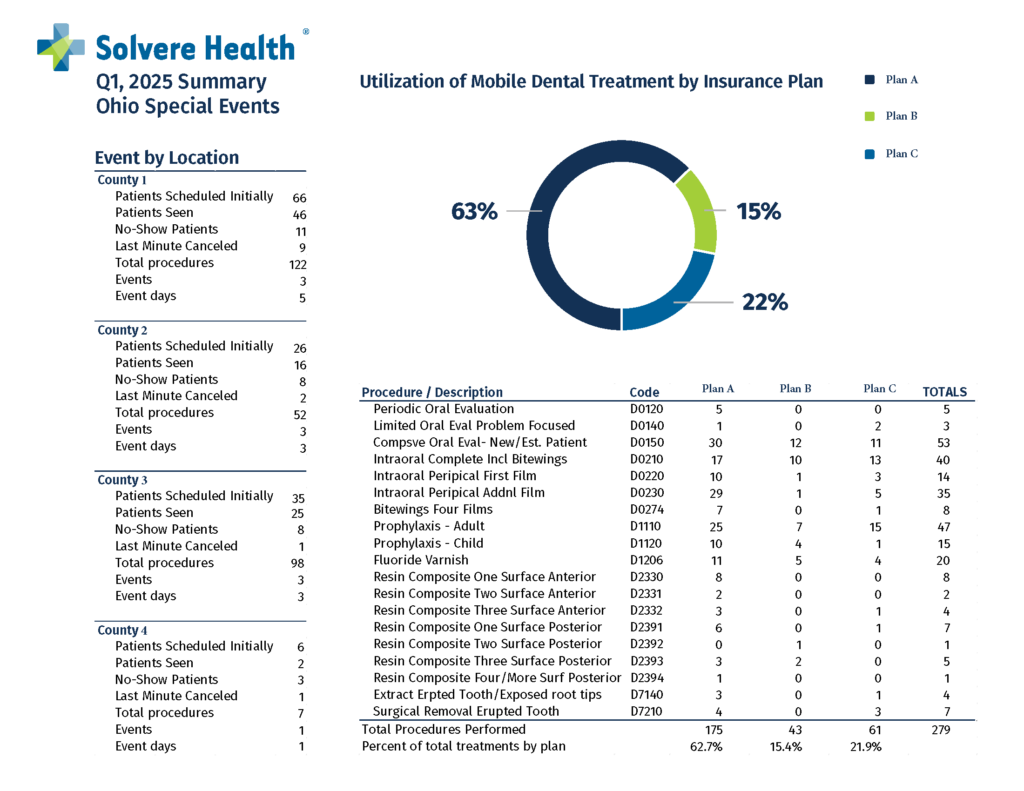
—we function as a Strategic Implementation Partner.
Through strategic infrastructure deployment and adequacy-focused implementation, Solvere Health enables states to achieve measurable improvements in access, availability, and compliance.
States partnering with Solvere Health experience strengthened provider networks, allowing Medicaid members and rural populations to access care more quickly and reliably. Wait-lists for general dentistry and specialty care are reduced, and provider availability increases in regions where fixed infrastructure alone cannot meet demand.
Time to first appointment —a critical network adequacy metric— is significantly improved, enabling members to receive care within clinically appropriate and regulatory timeframes. This directly supports compliance with CMS Medicaid access standards and Rural Health Transformation Program objectives.
In addition to improving compliance metrics, Solvere Health’s three pillar deployment model ensures that covered benefits are not only technically available, but operationally accessible to members. By aligning infrastructure with transformation goals, Solvere Health enables states to achieve sustainable, long-term improvements in care access (learn more).
Solvere Health transforms network adequacy from a regulatory requirement into an operational reality. We help deliver measurable, sustainable access improvements for Medicaid populations and rural communities.